
Partner allocations, from last year's software to every K-1

Partner allocations rarely start from a blank page. Last year's return already holds each partner's units, ending capital and unreturned capital. The partnership agreement already sets the allocation terms, the transfer rules and the order distributions are paid in. The work each year is carrying all of that forward, then layering on what changed.
This post follows one sample partnership through that work in Instead, in the order a preparer does it. Bring last year over from your other tax software, read the agreement, read last year's return and allocations, fill the partner allocations module, apply this year's changes, and carry it all through to every K-1.
Short answer. Start from last year's return and allocations, read the agreement for the allocation and distribution terms, prorate income for any mid-year transfer under section 706(d), run distributions through the agreement's waterfall tier by tier, and check that Box 19A on every K-1 matches the waterfall.
Start from last year's return and allocations
The starting point is what your firm filed last year.
Quillmere Freight Partners, LP is a sample limited partnership with three partners. Dana M. Okafor is the general partner with 400 units. Rui S. Castellanos holds 350 units and Imogen T. Hale 250, out of 1,000. Last year's return was prepared in another tax product.
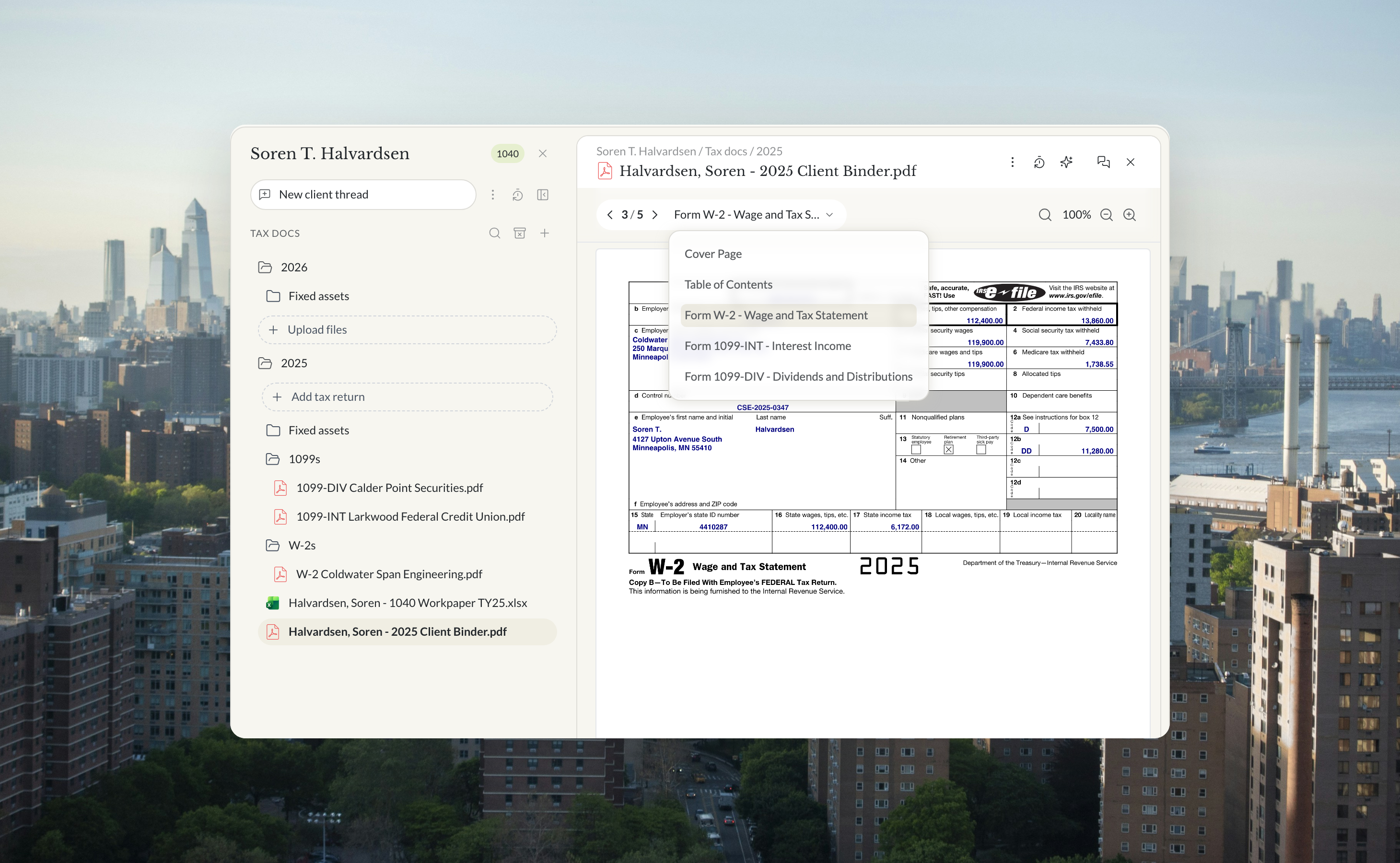
To bring it over, upload last year's Form 1065 return and partner allocations report from CCH Axcess Tax, UltraTax, Drake Tax or Lacerte to the client's tax docs in Instead, along with the partnership agreement. Then ask the agent to carry the allocations forward.

The agent reads the partnership agreement
The agreement decides how income is split, what happens when units change hands and who gets paid first when cash goes out.
The agent read the Quillmere agreement and pulled out the terms that drive the allocations. Percentage interests follow units out of 1,000. Dana receives a $240,000 guaranteed payment as general partner. Section 6.1 sets the distribution waterfall. First, each partner's accrued and unpaid 8% preferred return on unreturned capital. Second, the return of each partner's unreturned capital. Then 80% to the partners by percentage interest and 20% to the general partner as carried interest. Section 9.2 says a buyer of units succeeds to the seller's capital account and unreturned capital for those units, while preferred return accrued before the transfer stays with the seller.

Then last year's return and allocations
Last year's ending numbers are this year's starting point.
From the 2024 return and allocations report, the agent took each partner's ending capital and unreturned capital as the 2025 opening balances. Unreturned capital at December 31, 2024 was $240,000 for Dana, $210,000 for Rui and $150,000 for Imogen, $600,000 in total, with no accrued preferred return left unpaid. Beginning tax capital for 2025 was $2,061,755.20, $1,804,035.80 and $1,288,597.00.
It also checked the 2025 partner setup against those sources and found a problem. The $1,800,000 distributed on December 31, 2025 had been entered flat by percentage, $720,000, $630,000 and $450,000, and never run through the agreement's waterfall.

Into the partner allocations module, with a workpaper
The agent filled Instead's partner allocations module from those sources. It set the waterfall tiers from Section 6.1, recorded each partner's unreturned capital, replaced the three flat distribution rows and recomputed the K-1s. It saved the support as a workpaper in the client's tax docs, with tabs for the summary, the preferred return, the waterfall and the K-1 allocations.
This year's changes, on their dates
Two things changed in 2025, and each one lands on its own date.
On July 1, 2025, Rui sold 50 units to Imogen, 5% of the partnership. Rui went from 35% to 30% and Imogen from 25% to 30%. Dana stayed at 40%.
Section 706(d)(1) requires each partner's distributive share to take into account the partners' varying interests during the year. Treasury Regulation section 1.706-4 gives two methods, an interim closing of the books, which is the default, or a proration of the year's items by days held, which the partners must agree to. The Quillmere agreement calls for proration. Prorated by days held, Rui's weighted interest for the year is 32.4932% and Imogen's 27.5068%. Those percentages split ordinary business income of $1,574,300 into Box 1 of $629,720, $511,540 and $433,040.
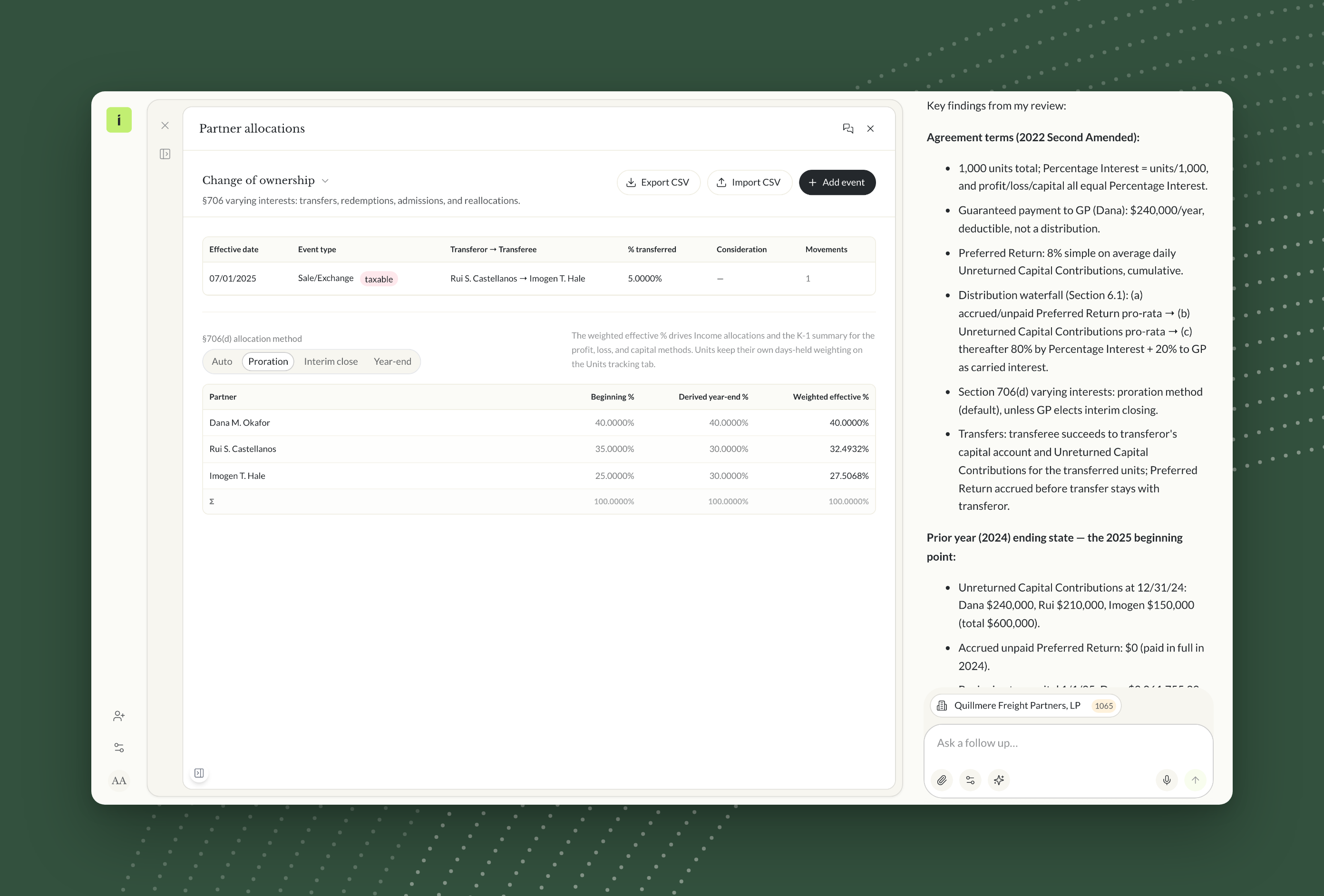
The second change is the $1.8 million distribution. Income follows the weighted percentages, but cash follows the agreement. That means running the $1,800,000 through the waterfall.
A worked waterfall, $1.8 million in four tiers
Here is how the $1,800,000 distributed on December 31, 2025 moves through Section 6.1, partner by partner.
Tier (a), preferred return. 8% on $600,000 of unreturned capital is $48,000. Dana's share is $19,200.00. Rui's $15,590.14 and Imogen's $13,209.86 reflect the capital each held before and after the July 1 transfer, with the preferred return accrued before the transfer staying with Rui under Section 9.2.
Tier (b), return of unreturned capital. $600,000 goes back to the partners. Dana gets $240,000. Rui and Imogen get $180,000 each. Imogen's $180,000 is her own $150,000 plus the $30,000 of unreturned capital that came with Rui's 50 units under Section 9.2. Applying Section 9.2 here moved $30,000 from Rui to Imogen.
Tier (c)(i), 80% by percentage interest. After tiers (a) and (b), $1,152,000 remains. 80% of it, $921,600, goes by percentage interest on the distribution date, 40%, 30% and 30%. That is $368,640, $276,480 and $276,480.
Tier (c)(ii), 20% carried interest. The other 20%, $230,400, goes to Dana as general partner.
| Tier | Dana (GP) | Rui (LP) | Imogen (LP) | Total |
|---|---|---|---|---|
| (a) Preferred return, 8% on $600,000 | $19,200.00 | $15,590.14 | $13,209.86 | $48,000.00 |
| (b) Return of unreturned capital | $240,000.00 | $180,000.00 | $180,000.00 | $600,000.00 |
| (c)(i) 80% by percentage interest, 40/30/30 | $368,640.00 | $276,480.00 | $276,480.00 | $921,600.00 |
| (c)(ii) 20% carried interest to the GP | $230,400.00 | $0.00 | $0.00 | $230,400.00 |
| Total distribution, Box 19A | $858,240 | $472,070 | $469,690 | $1,800,000 |
Compare that with the flat entry the agent replaced. By percentage alone, Dana would have received $720,000, Rui $630,000 and Imogen $450,000. Through the waterfall, Dana receives $858,240, Rui $472,070 and Imogen $469,690. The total is the same $1,800,000, but each partner's Box 19A is different.

Through to every K-1
The allocations only count once they reach the return.
The 2025 Form 1065 recomputes, and each partner's Schedule K-1 in the return carries both changes. Imogen's K-1 shows Box 1 ordinary business income of $433,040 and Box 19A distributions of $469,690, the waterfall total. Item J shows her profit, loss and capital at 25% beginning and 30% ending. Under the Partner's Instructions for Schedule K-1 (Form 1065), Item J reports the percentages at the beginning and end of the year, so a mid-year sale shows up there for both the buyer and the seller. Ending tax capital is $2,215,240 for Dana, $1,611,131 for Rui and $1,711,729 for Imogen.

People still review the work. The request, the agent's findings and every change stay in the client thread, and the workpaper ties each K-1 amount back to the agreement, last year's balances and this year's events.
Questions to ask before you commit:
- Can it start from last year's return and allocations from the software you use today?
- Does it read the partnership agreement, not just the percentages?
- Does it carry ending capital and unreturned capital forward as this year's opening balances?
- Does it record transfers on their dates and prorate income by days held?
- Does each partner's Box 19A match the agreement's waterfall?

Free white paper
Partner allocations
From last year's software to every K-1
Carrying allocations forward from last year's return, the partnership agreement, mid-year transfers and the distribution waterfall, through to the K-1s. Free PDF.
Download the white paperHow do you carry partner allocations forward to the K-1s?
Start from last year's return and allocations, read the agreement for the allocation and distribution terms, record this year's transfers on their dates, run distributions through the waterfall, and check every K-1. The Instead AI tax platform does that work from one request in the client thread.
For more depth, download the white paper. To see it on your own partnerships, start your trial at instead.com.
Frequently asked questions
How do you bring partner allocations over from another tax software?
Upload last year's Form 1065 return and partner allocations report from CCH Axcess Tax, UltraTax, Drake Tax or Lacerte to the client's tax docs in Instead, along with the partnership agreement. The agent reads them and carries the ending balances forward.
What is a distribution waterfall in a partnership?
A distribution waterfall is the order the partnership agreement sets for paying out cash. A common order pays a preferred return first, then returns each partner's unreturned capital, then splits what is left, often with a share to the general partner as carried interest. Each partner's total is reported in Box 19A.
Do distributions follow the same percentages as income?
Not always. Income follows each partner's interest during the year, prorated for any mid-year change. Distributions follow what the partnership agreement says, which may be a waterfall. In the example, the $1.8 million went $858,240, $472,070 and $469,690, not the $720,000, $630,000 and $450,000 a flat split would give.
What happens to unreturned capital when a partner sells units?
It depends on the partnership agreement. In the example, Section 9.2 of the agreement passes the seller's capital account and unreturned capital for the sold units to the buyer, while preferred return accrued before the sale stays with the seller. Imogen's $180,000 return of capital includes $30,000 that came with Rui's units.
Is the interim closing method or the proration method the default?
The interim closing method is the default under Treasury Regulation section 1.706-4. A partnership can use the proration method only by agreement of the partners, meaning an agreement of all the partners in a dated, written statement that is kept with the partnership's books and records.
What goes in Item J of Schedule K-1 after a mid-year sale?
Item J shows the partner's profit, loss and capital percentages at the beginning and end of the year. After a mid-year sale both columns change for the buyer and the seller, and the seller's Sale checkbox is checked, whether or not any gain or loss was recognized on the sale.


The Destruction of the Billable Hour: AI's Impact on Accounting Firm Pricing in 2027

Year-End Tax Planning 2026: Checklist of Strategies by Dec 31



.png)