
The Destruction of the Billable Hour: AI's Impact on Accounting Firm Pricing in 2027

For most of its history, an accounting firm has run on two inputs, people and capital. A third has arrived. Intelligence, delivered by AI agents, is taking on a growing share of the work in accounting, tax, audit and consulting, and it changes how every engagement should be priced.
Our new white paper, The destruction of the billable hour, sets out what that means for firm economics in 2027. This post summarizes it, and the full paper is a free download further down this page.
Short answer: When one person runs agents across many clients at once, hours times rate stops computing. Price from cost, complexity or value.
Labor, capital and now intelligence
Intelligence is a new direct cost in every engagement, and it behaves differently from people and technology.
A firm spends its revenue in three places: cost of sales, operating expenses and profit. A common rule of thumb has been roughly one third each, and cost of sales meant people. Their hours were the cost of the work and, through hourly rates, the basis of the price.

Where the revenue dollar goes. The historical split is a rule of thumb. The split with agents is illustrative and varies by firm.
An engagement’s cost now has three parts: human cost, other capital such as technology, and intelligence cost. The third varies with the client’s complexity, the tools the firm uses and the models behind them.
Why hours times rate stops computing
The hour no longer maps to one client, so a time entry no longer measures the work.
78% of firms still use hourly billing, according to the Thomson Reuters Institute (October 2026). Yet in a 15 minute block, one person can now kick off agentic workflows across six clients, then review, give feedback and steer them through the day. The same pattern scales to 60 or 150 clients worked in batches. So which client gets the hour?

One professional’s day, illustrative.
Review changes too. Suppose reviewers go through 250 consecutive partnership returns and make no edits to the returns or to the requests sent to clients. A firm may then stop reviewing every return and run a control framework over the system, the way no professional reviews every transaction on a bank feed but checks the control totals. People still supervise and review, as in AI tax return review, but they supervise the system rather than each record. For partnership work on an agent platform today, see how 1065 filing works with Instead.
Why deployment is the real bottleneck
The technology to do the work exists. Deploying it across a firm is the harder problem.
Most firms have tried a general AI assistant. Far fewer have deployed agents that complete a whole client engagement. Many systems of record in tax, audit and accounting are legacy desktop software built long before agents, and agents struggle to operate them.
So each firm faces a choice. It can let agents work inside those tools, where changes are hard to version or trace, or move the work to agentic systems that version every change end to end, so people can observe, train and correct the agent. If you are weighing that move, start with what to ask an AI tax vendor and plan the rollout in stages.
Five ways accounting firms will price in 2027
None of these models is computed from hours, and most firms will combine more than one.
These are patterns we see firms on Instead using, or planning to use, over the next year:
- A multiple of intelligence cost. Apply a firm multiple to what the agent work costs. In a simple example on a small tax return, not a recommended price, a $100 agent cost at 20x prices the return at $2,000, and people reviewing and advising bring the total cost to $300 to $500.
- Cost plus a gross margin target. Add human and agent cost for each client, then price to the target margin. It suits firms that already run dashboards that track advisory profit margin.
- Complexity of inputs and outputs. Price from entities and documents in, forms and jurisdictions out, and the complex scenarios between. An agent can now run this on every client, which used to take too long.
- Value-based pricing. Price to the value the client receives, such as the tax savings delivered. In some services it is the wrong basis. Pricing an audit on its opinion would not be appropriate.
- Complexity add-ons. Start from any base price and add for urgency, entities, foreign currencies, investor reporting, R&D credits, multi-state work or complex K-1s.
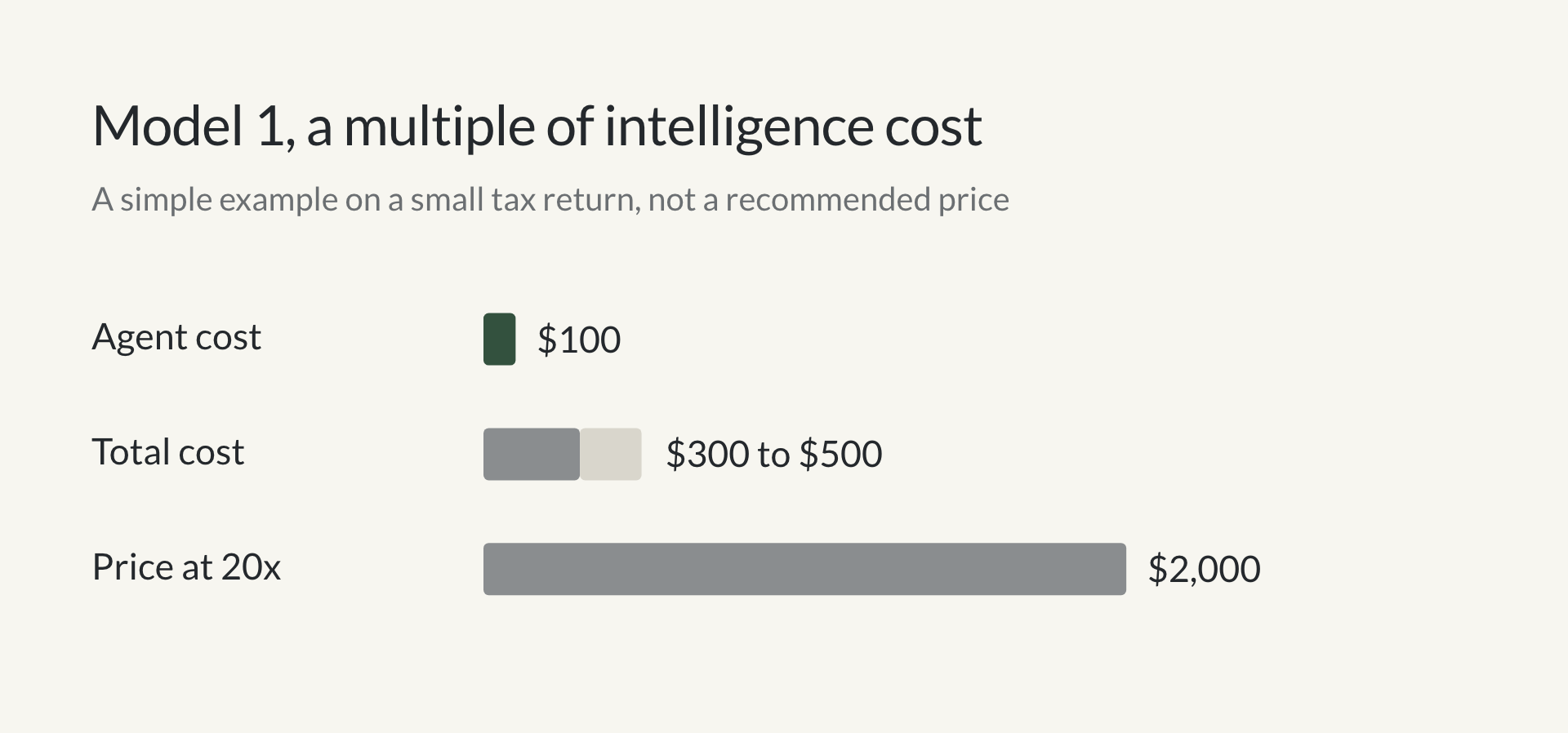
Model 1, a simple example on a small tax return, not a recommended price.
What matters is one written policy that every price traces back to. That moves the hard part from calculating prices to deploying them.
How to deploy a new pricing model with control
Choosing a model is a strategy decision. Rolling it out is an operations problem.
Consider a firm with 70,000 engagement letters to send in a short window. Agents can follow the pricing policy, read each client’s records, email and call transcripts, and render each letter from that policy. In Instead, Client Grid lets a firm prompt hundreds or thousands of clients at once and run those steps in one agentic workflow, the idea behind AI tax orchestration.
Before you roll out, answer five questions:
- Clients. Are all of your clients in one system an agent can work across?
- Policy. Is the pricing policy defined, and who owns it?
- Letters. Which system sends letters and collects signatures?
- Controls. What confirms the agent calculated each price correctly?
- Terms. Do your letter terms let you correct a price in year one?
With that many dynamic prices, an agent can get one wrong in the first year, and the firm should not be held to it.
Where the accounting firm goes next
We believe agents will run the professional services firm end to end, with people supervising throughout.
Agents will draft engagement letters, raise client requests, route documents, deliver results and follow up on billing. What sets a firm apart is its own intelligence: what its professionals know, and the documents, examples and standards no off-the-shelf model has.
Many services will go to zero, the way the cost of a journal entry did. Losing the bundle of tasks that makes up a job today does not mean losing the career. It means going deeper for clients.
Free white paper
The destruction of the billable hour
AI’s impact on accounting firm pricing in 2027
Why hours times rate stops computing, why deployment is the bottleneck, five ways firms will price, and how to roll a new model out with control. 22 pages, free PDF.
Download the white paperHow should your accounting firm price in 2027?
The Instead AI tax platform runs agent work across every client with people supervising and every change tracked, so a pricing policy can be applied and checked at scale.
For the five models, the rollout questions and five steps to start, download the white paper. To see it on your own clients, start your trial at instead.com.
Frequently asked questions
Q: Why does AI break hourly billing for accounting firms?
A: One professional can now start and steer agent work across many clients in the same block of time. A time entry against any one client no longer measures the work.
Q: What are the five ways accounting firms will price in 2027?
A: A multiple of intelligence cost, cost plus a gross margin target, complexity of inputs and outputs, value-based pricing, and complexity add-ons. Firms can combine them under one written pricing policy.
Q: Do I need to fill in a form to read the white paper?
A: No, you do not need to fill in a form. The white paper is a free PDF download on this page.

Year-End Tax Planning 2026: Checklist of Strategies by Dec 31
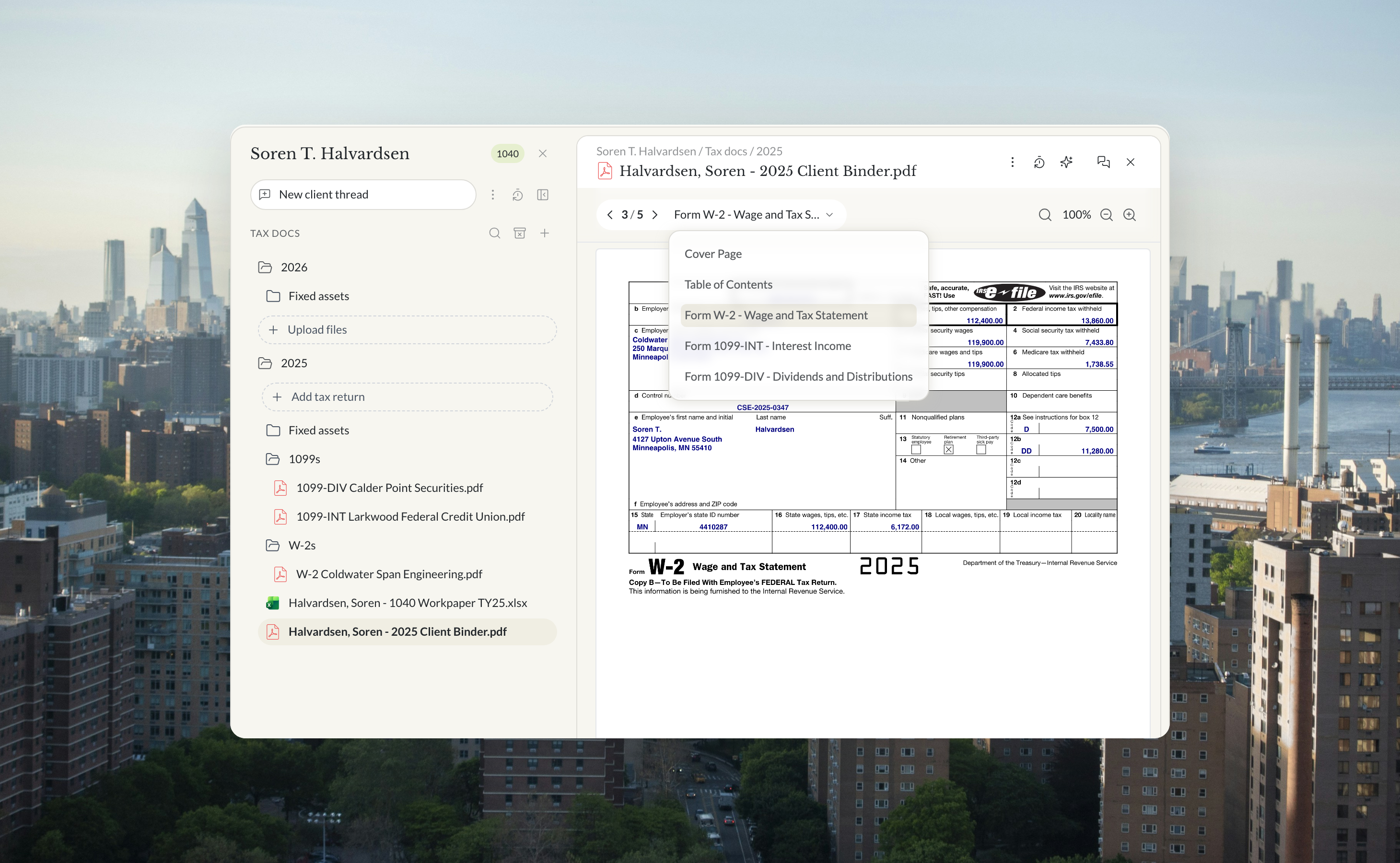

How AI Tax Orchestration Works in Instead

.png)



.png)