
OBBBA senior deduction $6,000 for age 65 plus in 2026

If you are 65 or older, a new federal deduction is available starting with tax year 2025. The One Big Beautiful Bill Act created a temporary deduction of $6,000 per qualifying senior, available for tax years 2025 through 2028, regardless of whether you itemize. For married couples filing jointly where both spouses are 65 or older, the combined benefit is $12,000. This deduction is established under Section 70103 of the OBBBA, amending Section 151 of the Internal Revenue Code. Because it is separate from both the standard deduction and the additional standard deduction for age, it stacks on top of both, reducing taxable income by an additional $6,000 per qualifying senior.
Expiry notice: The senior deduction is available for tax years 2025 through 2028 only. Taxpayers aged 65 or older should plan their MAGI position now for all four years before the provision sunsets.
OBBBA senior deduction rules 2025 to 2028
OBBBA Section 70103 creates a new deduction of $6,000 for taxpayers age 65 or older, placed under Section 151(d)(5)(C) of the Internal Revenue Code. The deduction is temporary, covering tax years 2025 through 2028 only. If you are filing a 2025 return in 2026, this benefit applies now. It will expire after the 2028 tax year unless future legislation extends it.
Unlike above-the-line adjustments that reduce adjusted gross income on Schedule 1, the Section 70103 senior deduction reduces taxable income directly, in the same step as the standard deduction. This means it lowers the amount of income subject to tax but does not change your AGI. Both standard deduction users and itemizers can claim it, which is an unusual feature of this provision.
For married filing jointly, each spouse who is 65 or older gets a $6,000 deduction. A couple where both spouses qualify can claim a combined $12,000. If only one spouse meets the age requirement, the household claims $6,000. The IRS has not yet issued final guidance on where this deduction appears on the return. Confirm with your tax software before filing, and keep a supporting worksheet.
This deduction stacks on top of the existing additional standard deduction for age. For 2025, single filers 65 and older already receive an additional standard deduction of $2,000, and married filers receive an extra $1,600 per qualifying spouse. The OBBBA deduction does not replace those amounts. A single filer over 65 can reduce taxable income by $6,000 through the new deduction and still receive the $2,000 additional standard deduction on top of the updated base amount.
Who qualifies for the $6000 senior deduction
You qualify if you are at least 65 by the end of the tax year, have a recognized IRS filing status, and your modified adjusted gross income is below the phaseout ceiling.
Your age test is straightforward. For the 2025 tax year, if you were born before January 1, 1961, you meet the age requirement. Note that the IRS treats taxpayers as having attained age 65 on the day before their birthday, so taxpayers born on January 1, 1961 are also considered to have reached age 65 by December 31, 2025.
The income phaseout deserves careful attention. The deduction reduces at a rate of 6% for every $1 of MAGI above the threshold. That math works out as follows:
- Single filers: phaseout begins at $75,000 MAGI, and the deduction is fully eliminated at $175,000 MAGI.
- MFJ filers (both 65+): phaseout begins at $150,000 MAGI, and the $12,000 combined deduction is fully eliminated at $350,000 MAGI.
- MFJ filers (one spouse 65+): phaseout begins at $150,000 MAGI, and the $6,000 deduction is fully eliminated at $250,000 MAGI.
Example for a single filer at $100,000 MAGI: the excess above the $75,000 threshold is $25,000. Multiply $25,000 by 6%, which equals a $1,500 reduction. The available deduction is $6,000 minus $1,500, for a total of $4,500.
Social Security income counts toward MAGI for this phaseout. So do required minimum distributions from traditional retirement accounts, pension income, and investment earnings. All push your MAGI closer to or past the thresholds.
For married filing separately, use the single-filer threshold logic. The phaseout starts at $75,000.
Senior deduction mistakes and phaseout traps
Most errors happen when filers confuse this with the existing age-related additional standard deduction. The OBBBA deduction is a separate provision under Section 151. If you only update one part of your return and skip the other, you leave money on the table. Confirm both your standard deduction calculation and your Section 151 senior deduction in one pass.
- MAGI calculation errors: MAGI for the phaseout includes income sources people do not think of as "earnings." Social Security benefits, RMDs, capital gains, and tax-exempt interest all count. Calculate your full MAGI first, then apply the phaseout formula.
- Itemizers skipping the deduction: Itemizers sometimes skip this deduction because they assume it only applies to standard deduction users. It does not. Both itemizers and standard deduction filers can claim it.
- RMD-driven returns: Required minimum distributions begin at age 73 and push MAGI higher, potentially landing you in the phaseout zone or eliminating the deduction entirely. This is where Roth 401k conversion planning before RMD age becomes relevant, because Roth distributions do not count toward MAGI in retirement.
- Assuming permanence: The deduction covers tax years 2025 through 2028 only. Do not assume it continues beyond that window without new legislation.
How to claim the $6000 senior deduction in 2025
Confirm that one or both taxpayers are age 65 or older by December 31 of the tax year.
- Gather all income sources: Social Security benefits, pension payments, 401(k) and IRA withdrawals, RMDs, wages if still working, rental income, interest, dividends, and capital gains.
- Calculate your MAGI before applying this deduction. Include all income components and subtract other above-the-line deductions. This is the number you compare against the $75,000 (single) or $150,000 (MFJ) threshold.
- Apply the phaseout formula. If your MAGI is at or below the threshold, your deduction is the full $6,000 (or $12,000 for MFJ with both spouses qualifying). If your MAGI is above the threshold, reduce the deduction by 6% of the excess. The deduction cannot go below zero.
- Enter the deduction amount following your tax software's guidance for the Section 151 senior deduction. The IRS has not yet issued final guidance on the specific form line; confirm with your software provider before filing.
- Keep a worksheet documenting the age test, MAGI calculation, and phaseout math.
Before finalizing, verify:
- The threshold in your return matches your filing status.
- The deduction amount matches the phaseout formula.
- The deduction is reported separately from your standard deduction and age add-on.
- Your Traditional 401k or IRA contributions are reflected before finalizing MAGI.
Calculate your senior deduction after phaseout
Direct savings depend on your marginal federal tax bracket. At 10%, a $6,000 deduction saves $600. At 12%, $720. At 22%, $1,320. For a married couple both over 65 claiming $12,000 at 12%, the direct savings are $1,440.
A working estimate: a single filer claiming the full $6,000 at 12% gets at least $720 in direct federal savings. Because this deduction reduces taxable income rather than AGI, it does not directly change the "combined income" figure used to determine how much of your Social Security benefits are taxable, nor does it affect Medicare IRMAA surcharges, which are based on prior-year MAGI. The value of this deduction is the direct reduction in the tax calculated on your taxable income.
In some cases, this deduction also affects state tax returns, depending on whether your state conforms to the federal change under Section 151. Verify your state's conformity with your tax software or advisor.
At higher MAGI levels, the phaseout bites. A single filer at $125,000 MAGI loses $3,000 of the deduction (6% of $50,000 excess above $75,000) and claims only $3,000. At $175,000, the deduction is gone.
Real-world example
Harriet is 69 and single, with 2025 income as follows: $32,000 in Social Security benefits, $22,000 in traditional IRA distributions, and $9,000 in interest and dividends.
Her MAGI is $63,000. Because she is below the $75,000 threshold, Harriet qualifies for the full $6,000 deduction. She takes the 2025 standard deduction of $18,750, which reflects the updated base of $16,750 under OBBBA Section 70102 (base $15,750 plus the $1,000 temporary boost for 2025 through 2028) and the $2,000 additional amount for age. She then claims the $6,000 Section 70103 senior deduction separately. Her taxable income is $38,250 ($63,000 minus $18,750 minus $6,000).
Without the OBBBA senior deduction, her taxable income would be $44,250. At the 12% bracket, the direct savings are $720.
Now consider a couple. Carl and Diane are both 66 and file jointly. Their 2025 income includes $54,000 total in Social Security, $44,000 in traditional IRA and 401(k) withdrawals, and $6,000 in investment income.
Their MAGI is $104,000. Both qualify for the age test, so their combined deduction is $12,000. They take the standard deduction of $36,700, which reflects the OBBBA Section 70102 base of $33,500 (base $31,500 plus the $2,000 temporary boost for 2025 through 2028) and the $1,600 age add-on for each qualifying spouse ($3,200 total). They then claim the $12,000 Section 70103 senior deduction separately. Their taxable income is $55,300 ($104,000 minus $36,700 minus $12,000).
Without the OBBBA senior deduction, taxable income would be $67,300. At the 12% bracket, direct savings are $1,440.
Your compliance roadmap
The IRS may still issue final guidance on how software displays this benefit. Keep a simple compliance workflow from 2025 to 2028.
- Confirm that your filing software supports the 2025 OBBBA provisions, including the Section 151 senior deduction, before you begin.
- Pull IRS Publication 554 and review the sections on income, deductions, and credits for older Americans. This publication covers the additional standard deduction for age, Social Security taxation thresholds, and filing requirements that interact with the new deduction.
- Confirm whether your state follows the federal change under Section 151. State conformity varies.
- Keep documentation supporting your age and income components. Date-of-birth evidence is useful during a review or audit.
- Track your return with a short memo: filing status, MAGI, phaseout calculation, deduction amount, and the line used. That memo turns a one-time calculation into a repeatable process for each of the four eligible years.
- Use the State Tax Deadlines page to avoid missing extensions and e-file windows.
Filing your return
Report the Section 151 senior deduction following your tax software's guidance. The IRS has not yet issued final line-level guidance on where this deduction appears on Form 1040. Review the final PDF before submitting to confirm the deduction is applied and that the amount matches your phaseout worksheet.
If filing electronically and your software shows an unexpected number for this deduction, investigate before submitting. For paper filing, keep your internal worksheet with your records.
If you missed the deduction on an already-filed 2025 return, file Form 1040-X. Keep supporting documents, because amendments that increase a refund can trigger IRS correspondence.
Before submitting, walk through this checklist: age status confirmed, MAGI calculated, phaseout formula applied, deduction entered on the correct line, and final taxable income reconciled with your worksheet.
Retirement tax strategies that stack with OBBBA
The strongest approach combines this new deduction with retirement-income strategies that keep MAGI stable over time.
A Traditional 401k account matters most once required minimum distributions begin at age 73. RMDs lift MAGI, which pushes you toward the phaseout zone. The senior deduction offsets part of that effect, but only if MAGI stays within range. In years with high RMD pressure, controlling unnecessary MAGI spikes becomes critical. Planning Roth conversions before RMD age can reduce the size of future mandatory withdrawals and ease pressure on this phaseout across all four eligible years.
A Roth 401k conversion strategy works hand-in-hand with the senior deduction. Converting traditional retirement assets to Roth before age 73 reduces future RMDs and keeps MAGI lower in retirement. The tradeoff is paying tax on the conversion now, but for someone who expects RMDs to push them past the phaseout threshold, the conversion math often favors acting sooner.
A Health savings account can be used in retirement for qualified medical costs if you retained assets from earlier contributions. Using HSA funds avoids converting additional retirement distributions into MAGI, preserving the senior deduction in tight years.
The Child & dependent tax credits connection is less common for this age group, but not rare. Grandparents caring for dependents may qualify for parallel deductions and credits that stack with the senior deduction.
Across all strategies, the objective is the same: keep MAGI stable and below phaseout thresholds for each of the four years this deduction is available.
Capture the full senior deduction before the 2028 sunset
The $6,000 senior deduction is available for 2025 through 2028. Taxpayers aged 65 or older who do not actively manage their MAGI during those four years risk phasing out of the deduction entirely, since it disappears at $175,000 for singles and $350,000 for MFJ couples where both spouses qualify. Traditional retirement contributions made before the filing deadline are one of the most direct ways to preserve eligibility. Instead calculates your exact MAGI position, shows the phaseout impact in real time, and models how each Traditional 401k or IRA contribution affects your senior deduction eligibility for the year.
Review Instead's pricing plans to start planning your 2026 senior deduction before the window closes.
Frequently asked questions
Q: Does the OBBBA $6000 deduction replace the standard deduction for age 65?
A: No. The existing additional standard deduction for age ($2,000 for single filers, $1,600 per qualifying spouse for MFJ in 2025) stays in place. The OBBBA deduction is a separate Section 151 deduction that stacks on top of it, so you can claim both if eligible.
Q: Can I claim the OBBBA senior deduction if I itemize?
A: Yes. The deduction is available regardless of whether you take the standard deduction or itemize. You do not need to take the standard deduction to claim this benefit.
Q: What is the income limit for the OBBBA senior deduction in 2025?
A: The deduction phases out based on MAGI. For single filers, the phaseout begins at $75,000, and the deduction is fully eliminated at $175,000. For MFJ with both spouses over 65, the phaseout begins at $150,000, and the $12,000 combined deduction is fully eliminated at $350,000. The reduction rate is 6% per $1 of MAGI above the threshold.
Q: Can both spouses claim $6000 each on a joint return?
A: Yes. If both spouses are 65 or older, each claims $6,000 for a combined $12,000 deduction. If only one spouse meets the age requirement, the household claims $6,000.
Q: Is the OBBBA senior deduction permanent, or does it expire?
A: No. The senior deduction under OBBBA Section 70103 is temporary, covering tax years 2025 through 2028 only. After 2028, the deduction expires unless Congress passes new legislation to extend it. Plan your retirement income strategy around that four-year window.
Q: Do RMDs and Social Security benefits count toward the senior deduction phaseout?
A: Yes. Required minimum distributions and Social Security income both count toward MAGI for this phaseout calculation. RMDs begin at age 73 and can be large enough to push MAGI past the phaseout threshold entirely. Converting traditional retirement assets to Roth before RMD age is one strategy to manage this, since Roth distributions do not count toward MAGI in retirement. Note that while this deduction reduces taxable income, it does not reduce AGI, so it does not directly affect Social Security taxation thresholds or Medicare IRMAA calculations, which are based on prior-year MAGI.

Year-End Tax Planning 2026: Checklist of Strategies by Dec 31
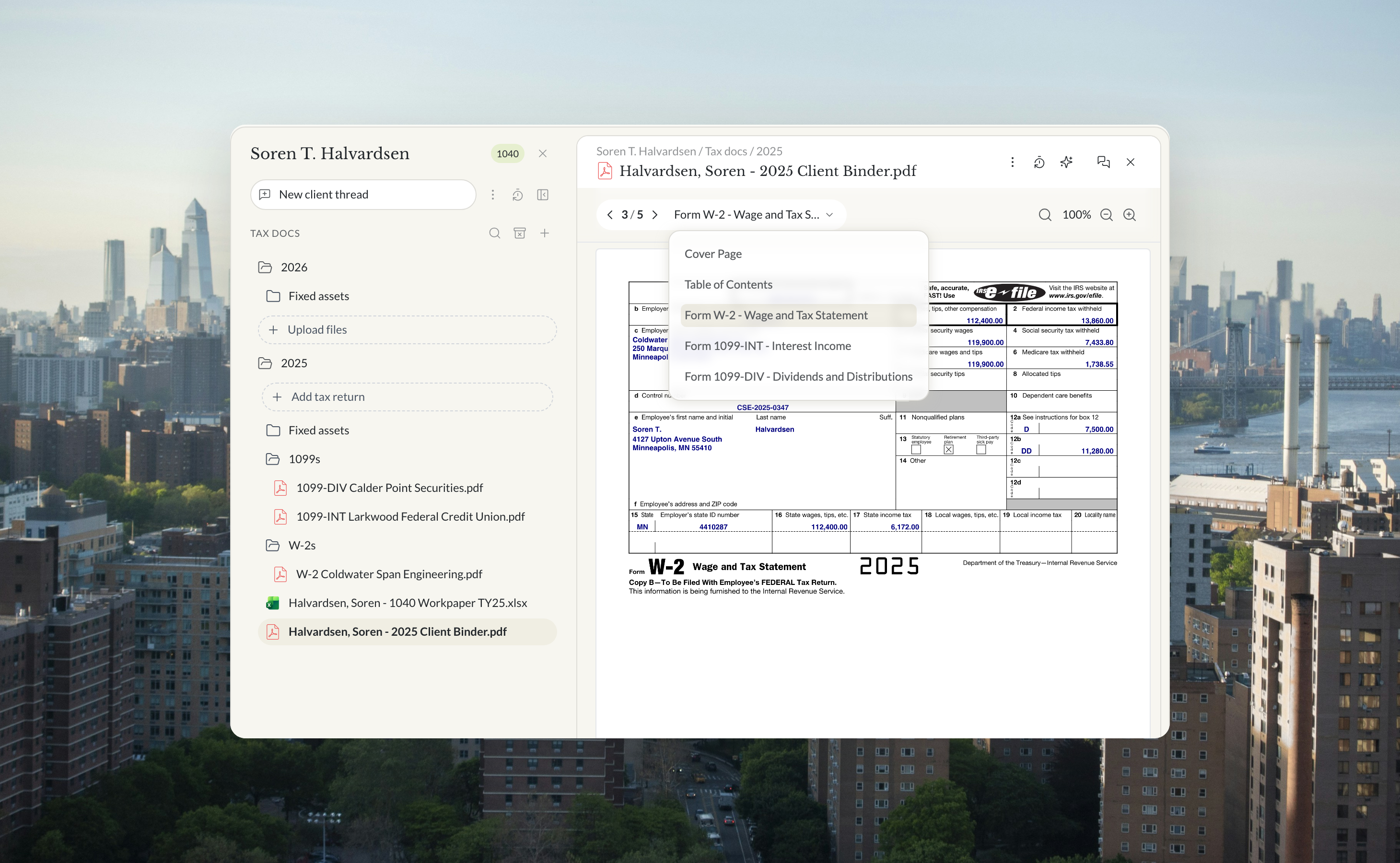

How AI Tax Orchestration Works in Instead

.png)



.png)